Music
Doornbusch’s compositional output spans electroacoustic works for instruments and electronics, fixed-media electronic music, solo and ensemble writing, choral music, and large-scale multimedia installations. His music has been performed in Argentina, Australia, Belgium, Canada, France, Germany, Ireland, Italy, Japan, Lithuania, the Netherlands, New Zealand, Poland, Switzerland, the UK, and the USA.
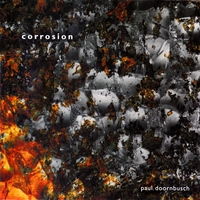
Works on Corrosion
Excerpts from all five works. Scores and performance materials available on request — see Contact.
-
Continuity 3 (2002)for percussion and computer
Uses transformations of performing technique and sound to explore relationships between continuous and discontinuous textures and structures. Three metallic sound-sources are processed in real time via Max/MSP; the computer acts as a resonating body extending and refracting the percussionist’s sounds. Performed by Timothy Phillips.
Excerpt: -
Continuity 2 (1999)for 4 bass recorders and electronics
Written for the Malle Symen recorder quartet (Amsterdam). Virtually no traditional sound-production; instead the physical components of playing — breath, embouchure, fingers — are disengaged and independently notated. The electronic part combines sampled concrete sounds with Xenakis’s dynamic stochastic synthesis technique. The electronic part has a separate existence as Continuity 1.
Excerpt: -
Act 5 (1998)for amplified bassoon, electronics, and hanging percussion
A theatrical work in which three large objects (pots and pans, a xylophone, a kettledrum) hang over a darkened stage and are released by the soloist to fall to the floor in turn. The bassoon part gradually opens from a restricted low register outward and upward. Performed by Hamish McKeich.
Excerpt: -
g4 (1997)electronic composition
Composed exclusively using Xenakis’s dynamic stochastic synthesis. Form is reminiscent of the abrupt, unpredictable layer-structures of Xenakis’s Gendy3, but with greater internal complexity and denser conglomerate textures — a tribute to Xenakis’s work that simultaneously opens its own direction.
Excerpt: -
Strepidus Somnus (1997)for 4 mixed voices and electronics
Four vocalists perform with earpieces, each reproducing a precomposed track of vocal material ranging from coital gasps to algorithmically-fractured English. The aim is parallel streams of quasi-improvisatory consciousness, with occasional coordinated moments creating a floridly surrealist sense of dislocation. At 27 minutes, the longest work on the album.
Excerpt:
Other Recordings
The Frog Peak Collaboration Project (Frog Peak Music: FP007, 1997) — includes Iceberg (1995). Apple Music
Continuity 4 (2013)
For piano and computer. Available in three versions: performed by a human pianist; performed by a MIDI player piano (pianola); and as a fully realised piano-and-computer work. The piece explores the realm of 20th century piano works from Ligeti to Stockhausen, Feldman, Nancarrow and more. It explores the timbre and performance practice of piano through extremes of playing technique and extends that through real-time computer processing.
It was exhibited at Musica ex Machina at EPFL Pavilions, Lausanne, from September 2024 until July 2025, where the pianola version ran continuously in the exhibition space.
MIDI player piano (pianola) version, Musica ex Machina, EPFL Lausanne, 2024.
Yamaha MIDI player piano recording, Musica ex Machina, EPFL Lausanne, 2024. Different performance from the video above.
Continuity 4 — with ElectronicsMultimedia and Installation Works
Musica ex Machina — Machines Thinking Musically (2024–2025)
Co-curated exhibition at EPFL Pavilions, Lausanne, Switzerland, with Sarah Kenderdine. The exhibition traced algorithmic and computational thinking in music from medieval theory to modern artificial intelligence, combining historical instruments, archival material, and new digital works including Continuity 4.
Murten Panorama (2024)
An accurate acoustic reconstruction of the soundscape of the Battle of Murten (1476), created for the Murten Terapixel Panorama installation. Historical research and spatial audio design were used to reconstruct what the battle would have sounded like from a specific vantage point, integrating period-accurate sounds into an immersive panoramic environment.
PLACE-Hampi (2006)
A large-scale media installation: stereoscopic panoramas of the ancient temple complex at Hampi, Karnataka, India, combined with field recordings, ambisonic spatialisation, 3D sound, and music. A collaboration with Jeffrey Shaw and L. Subramaniam.
Sacred Angkor (2004)
The world’s first stereographic spherical panoramic capture of a world heritage site. The fifty-minute, nine-panorama installation presents high-resolution immersive stereoscopic panoramas of the UNESCO-listed Angkor, Cambodia. Spatialised soundscapes combine in-situ field recordings from across the site, high-fidelity musical compositions reflecting temple life, and voiceover narration — all shaped to the contemplative circumambulatory design of the virtual environment. Collaboration with Sarah Kenderdine.
Complete Works
Works marked † appear on the Corrosion album above.
Chamber Music
-
M1 (1995)Any homophonic instrument & fixed media (2 tracks)
An early exploration of the relationship between a live soloist and pre-composed electronic materials; the electronics interact with and respond to the acoustic qualities of any monophonic instrument.
-
M2 (1995)Any homophonic instrument & fixed media (2 tracks)
A companion piece to M1 exploring contrasting approaches to the interaction between soloist and electronic materials.
-
Structured Luck (1996)Amplified bassoon & fixed media (2 tracks) — also performed as electronics alone
Explores algorithmic processes of pushing musical instruments to their limits, for the electronics it is to breaking point, in conjunction with the distinctive timbral qualities of the amplified bassoon. Available in two versions: for bassoon and electronics, and for electronics alone.
Structured Luck — electronics Structured Luck — Bassoon and ElectronicsBassoon performed by Hamish McKeich.
-
On the Fence (1997)Flute & fixed media (2 tracks)
The title reflects an ambiguity at the boundary between acoustic and electronic worlds, where the fixed electronic part neither accompanies nor opposes the flute but maintains a parallel, uncertain relationship with it.
-
Assifxiation (1997)Amplified flute & fixed media (2 tracks)
A work for amplified flute and electronics that explores extended performance techniques and electronic transformation of breath and tone.
-
Act 5 † (1998)Amplified bassoon, electronics & hanging percussion
See Corrosion above.
-
Continuity 2 † (1999)4 bass recorders & fixed media (2 tracks)
See Corrosion above.
-
Continuity 3 † (2000)Percussion & computer
See Corrosion above.
Choral
-
Preludes (1994)4 mixed voices — text by T. S. Eliot
A choral setting of T. S. Eliot’s Preludes, using the poem’s spare rhythmic precision as the basis for a multi-voice compositional structure. An early work in which Doornbusch’s interest in text, timing, and structural data first appears.
Preludes -
Strepidus Somnus † (1997)4 mixed voices, fixed media & live electronics
See Corrosion above.
Piano
-
Lorenz (2005)Solo piano
A solo piano work derived from the Lorenz attractor — a chaotic dynamical system — using the equations’ outputs to determine musical parameters. One of Doornbusch’s clearest expressions of his interest in mapping structural data into musical form, and a tribute to the works of Conlon Nancarrow.
Lorenz -
Continuity 4 (2013)Piano and computer — also performed by MIDI player piano or solo pianist
See the featured section above. Video of the pianola version from Musica ex Machina is embedded there.
Electroacoustic
-
MFPG (1994)Fixed media (2 tracks)
MFPG (Music for Percy Grainger) is an early electroacoustic work exploring granular synthesis and spectral processing; among Doornbusch’s first computer-generated compositions. Written for the Melbourne Festival that year and played at a concert at the Grainger Museum.
MFPG -
Iceberg (1995)Fixed media (2 tracks)
A dense electroacoustic work featuring layered electronic textures and extended sound transformations. Released on the Frog Peak Collaboration Project compilation (FP007, 1997), which invited composers to compose a 60 second piece based on a 66 second soundfile of a text written and read by Chris Mann. This is a massive and varied sound voyage through the voice and its transformations..
Iceberg -
g4 † (1997)Fixed media (2 tracks)
See Corrosion above.
-
Continuity 1 (c.1999)Fixed media (2 tracks) — the electronic part of Continuity 2 as an independent work
The electronic component of Continuity 2, combining sampled concrete sounds with dynamic stochastic synthesis, realised as a standalone fixed-media work.
Continuity 1 -
Dialogus (2000)Fixed media (2 tracks)
An electroacoustic work exploring dialogue and tension between contrasting blocks of electronic sound material — continuity versus rupture, density versus sparseness.
-
Continuity 1W (2007)Live electronics with ambisonic spatialisation
A live performance work for electronics featuring multi-channel ambisonic spatialisation in concert contexts. The spatialisation unfolds the electronic material through physical space, making the listening environment itself a compositional parameter.
More information on compositions and performances can be found at the Living Composers Project. Scores and performance materials are available via email.